

The mechanism adds $60-100/t in costs on Ukrainian steel entering the EU, prices that European customers are not ready to absorb. With no exemption from Brussels and no quick fix in sight, Ukrainian steelmakers are caught between a war and a carbon wall.
What is CBAM for Ukraine?
For Ukraine, CBAM represents a direct cost factor for one of the country’s key export sectors. The mechanism is being introduced without a transition period, at a time when the country continues to face significant economic and operational challenges. Ukraine entered 2026, the first year of CBAM’s definitive phase, as an EU candidate country without a domestic carbon pricing system, without access to European decarbonisation funds, and with a steel industry still largely based on blast furnace (BF) technology installed in the Soviet era.
Under the mechanism, European importers of Ukrainian steel are required to purchase certificates priced in line with the EU carbon market. In Q1 2026, the price was set at EUR 75.36 per tonne of CO2. Ukraine’s domestic carbon levy, by comparison, remains below EUR 1 per tonne, resulting in minimal offset against CBAM costs.
The range of affected products includes those most significant goods for Ukrainian exporters: pig iron, billets, rebar, wire rod, flat products, and tubes and pipes – representing the core output of companies such as Metinvest, ArcelorMittal Kryviy Rih (AMKR), and Interpipe. At the same time, EU steel producers continue to receive free carbon allowances, which are set to be gradually phased out by 2034. As a result, their effective carbon cost exposure remains limited in the near future, while Ukrainian producers face CBAM-related costs from the outset.
CBAM also requires companies to measure, report, and have independently verified the exact embedded CO2 in every product exported to the EU at the level of individual production units, on a fixed quarterly schedule. This process is complex even under stable conditions. Ukrainian producers are facing additional operational constraints, including security risks related to shelling, disruptions in power supply and workforce availability.
How much will it cost Ukrainian steel exporters
Ukraine exported 4.76 million t of steel products to the EU in 2025 (under HS 72 and 73 codes), marking a 25% rise from 2024, according to Eurostat. However, this figure is well below the pre-war levels. Russia’s full-scale invasion dealt a severe blow to Ukraine’s steel exports, prompting producers to focus primarily on the European market. On the one hand, there were limited logistic possibilities for exports to far destinations as Russia blocked the Black Sea ports, so Europe became a safe haven. On the other hand, the EU supported Ukraine with autonomous trade measures, allowing a temporary exemption from duties and other trade measures.
As a result, the share of the EU market in Ukraine’s steel exports expanded from 35% in 2021 to more than 60% in 2025. Poland, Bulgaria, Italy, Romania, and Greece were the key destinations.
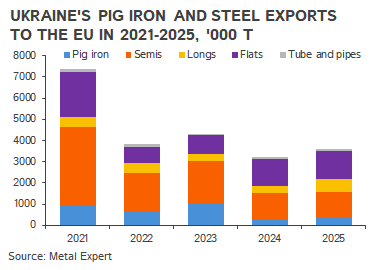
The steepest and most sustained decline occurred in the semis segment – the backbone of Ukraine’s pre-war export profile. After reaching 3.7 million t in 2021, shipments fell to 1.15 million t in 2025, with no meaningful recovery in sight. Pig iron exports proved equally volatile, collapsing in 2024 before partially rebounding to 411,000 t in 2025.
Finished products tell a more resilient story. Flat steel supplies recovered from a 2022 low of 750,000 t to around 1.3 million t in 2024-2025. Long steel was the only category to exceed the pre-war volumes, rising from 433,000 t in 2021 to 644,000 t in 2025.
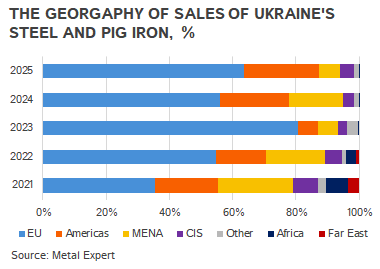
The sales geography has narrowed considerably to focus primarily on the European market. Ukraine has almost entirely shifted its focus to the more logistically accessible western markets, whilst losing a significant share of its presence in remote regions like Asia and MENA due to the logistical challenges posed by the war.
The key issue is the relatively high carbon intensity of Ukrainian steel production. On average, emissions may reach up to 2.3 t of CO2 per tonne of steel, compared to approximately 1.2 tonne in the EU. This gap largely reflects differences in technological structure, as around 88% of Ukrainian steel is produced via the BF-BOF route, including the continued use of open-hearth furnaces, which are considered outdated and highly emission-intensive.
According to the comment of the Green Transition Office (an independent advisory body under Ukraine’s Ministry of Economy, Environment and Agriculture) to Metal Expert, the cumulative direct financial losses for Ukrainian steel exporters from CBAM over the full 2026-2034 implementation period could reach EUR 4.2-4.9 billion under a “business as usual” scenario, that assumes current export volumes, current embedded emissions levels, and no functional domestic emissions trading system. This estimate covers only direct losses to exporters and excludes broader economic spillovers such as GDP decline, capital investment losses, and job cuts.
Ukraine versus other exporters
The EU is the world’s major steel importer, bringing in about 50 million t of steel products annually under HS code 72. Turkiye, Russia, India, China, and Ukraine are its five largest external suppliers, all competing for the same European buyers, primarily in flat steel products, longs, and semis. Before the war, Ukraine held a modest EU market share. After 2022, European buyers became dominant customers for Ukrainian producers. That shift created deep dependency on a single market and left Ukraine uniquely exposed when CBAM arrived.
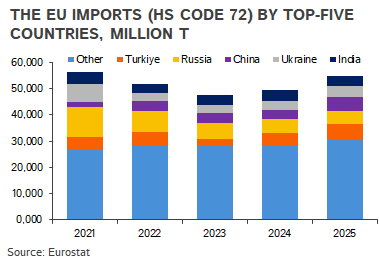
CBAM affects all steel exporters to the EU, but not equally. These countries compete with Ukraine for the same buyers. “Major steel-producing countries can flexibly reallocate their output: supplying ‘cleaner’ steel to the EU, whilst directing products with a higher carbon footprint to other markets. Ukrainian companies do not have this option due to their dependence on the European market and the lack of alternative production capacity. As a result, they are forced to cut back on supplies to the EU,” a representative of Metinvest told Metal Expert.
Turkiye produces steel at around 0.9 t of CO2 per tonne, more than twice as clean as Ukraine, because 75% of its steel comes from EAFs that use recycled scrap. Turkiye is also building its own carbon market, which would further reduce its CBAM bill.
India is in a similar position to Ukraine, with emissions of 2.5-3 t of CO2 per tonne. Indian steel exports to the EU fell by 11% in 2025. China sits at about 1.7 t of CO2 per tonne. Russia, which matches Ukraine’s intensity, is largely cut off from EU markets by sanctions.
Meanwhile, EU steelmakers are investing heavily in green production. Sweden’s Stegra (formerly H2 Green Steel) is launching hydrogen-based steel in 2026. Sweden’s HYBRIT project and Germany’s ThyssenKrupp are building new low-emission plants. European governments have committed around EUR 14.6 billion in grants for steel decarbonisation. In the meantime, Ukrainian companies have no access to such funds.
Ukrainian producers move to CBAM from different start points.
Metinvest used to be Ukraine’s largest steelmaker. It is still running two big plants, namely Zaporizhstal in Zaporizhzhia and Kamet Steel in Kamianske, while Mariupol assets, once securing 65% of its capacity, were destroyed by Russian occupation in 2022.
Before the war, Metinvest had plans to transform its production in a greener way. The group was evaluating the installation of EAF at Zaporizhstal to replace open-hearth technology, the modernisation of Kamet Steel and Ilyich Steel, and a transition pathway toward low-carbon steel aligned with EU requirements. The decarbonisation programme was estimated at $8 billion and mapped out over a 7-8 year horizon, with preparatory work already underway and preliminary agreements with technology partners in place. The war ended all of it. “We didn’t have time to get ready because of the war. We planned to upgrade our plants for steel production with a low carbon footprint [...] All EU steelmakers commenced the green transformation around the same time, but we lost two years at least. Currently, we are unable to invest in large-scale projects in Ukraine as investors cannot provide funds at reasonable interest rates,” Yuriy Ryzhenkov, Metinvest Group’s CEO, stated.
Decarbonisation plans of Ukrainian metallurgy
| Company | Plan | Status |
| AMKR | ||
| AMKR | Decommissioning of two coke batteries | Finished |
| AMKR | Decommission of the sinter plant | Finished |
| Mining Department | Pelletizing plant | Postponed |
| Mining Department | DRI modules | Announced |
| AMKR | BF No.7 desomissioning | Postponed |
| AMKR | Flat steel production | Undefined |
| Metinvest | ||
| Central GOK | DR-pellets | In progress |
| Northern GOK | DR-pellets | In progress |
| Kamet Steel | New EAF of 3.2 million tpy | Announced |
| Zaporizhstal | New EAF of 3.5-3.8 million tpy | Announced |
| Zaporizhstal | Closed open-hearth shop | Postponed |
| Azovstal | New EAF shop based on DRI modules | Under Russian occupation |
| Ilyich Steel | Under Russian occupation | |
| Interpipe | ||
| Interpipe Steel | EAF with slab and flats production | Announced |
| Interpipe Niko Tube | New investment projects in the pipe and railway divisions | In progress |
| Interpipe NTZ | ||
| Interpipe NMTZ | ||
| DCH Steel | ||
| Dnipro Metallurgical Plant | New EAF (n/a capacity) | Announced |
Source: Metal Expert
The company is actively arguing for a 3-5 year delay on CBAM for Ukraine. “Under the guise of the green agenda, a tax has been introduced that in reality has little to do with environmental protection. It is a tool for protecting the European market and stimulating European exports. As a result, we are being forced to reduce supplies because we cannot compete there,” Oleksandr Vodoviz, head of the CEO’s office at Metinvest Group, stated at the Forbes Ukraine Export Summit in 2026.
Metinvest lost orders for billets and long products totalling over 240,000 t in Q1 2026, and plans to export approximately 600,000 t of pig iron to the EU fell through, since customers backed out due to CBAM risks, Metal Expert learnt.
At the same time, keeping in mind risks and seeking opportunities, the company is building a new green steel plant in Italy’s Piombino, in partnership with Danieli, with a target start date of 2028. This shows the group’s strategy to invest in clean production inside the EU, while trying to buy time for its Ukrainian assets.
AMKR is the most seriously affected producer. The company has been operating at a loss for five consecutive years, surviving solely on more than $1 billion in support from its parent company, ArcelorMittal.
Before the invasion, AMKR had a roadmap for green steel transformation, financed in part by the group-wide decarbonisation programme. After the full-scale invasion, these funds were redirected to wartime operational survival.
In early 2026, AMKR’s CEO Mauro Longobardo stated that the company was forced to minimise the capacity utilisation, Metal Expert reported. The blooming shop was stopped. The company announced the closure of a subsidiary plant shortly after. “The plant is already operating at around 50% of its pre-war capacity, and the further decline in orders is forcing us to review our production schedule. For our mill, this is almost a knockout blow, as the company had planned to ship 1.25 million t of products to the EU in 2026 – around half of the planned output. In Q1 2026, we have already lost 300,000 t of exports. This means a shortfall in hard currency, unpaid taxes and duties, and job cuts. The market we spent three years building from scratch has closed on us,” AMKR representative told Metal Expert.
Energy costs are aggravating the situation. Electricity prices surged as a direct result of Russia’s attacks on the Ukrainian power grid. AMKR had a funded plan for green steel transformation before the invasion, but this plan is now cancelled. “Currently, we do not have any funding for investing in this type of technology. So, we were expecting (and that is not only our case) a waiver for CBAM. At least, for a certain period. This waiver would allow us, right after the war finishes, to start a normal business again and to accumulate enough finances for this type of investments,” Mauro Longobardo explained.
Interpipe is in an absolutely different position. Its steel plant uses an EAF that runs on about 90% recycled scrap metal. This makes it one of the cleanest steel producers in Ukraine, with an emissions intensity of around 0.3 t of CO2 per tonne. In May 2025, it published a formal Decarbonisation Pathway, targeting CO2 reductions of 25-26% per tonne of finished product by 2030.
However, the company is also facing CBAM challenges. There are incorrect numbers in the European Commission’s reference database, so European customers do not want to buy “dirty” steel products. “Despite its “green” production profile and low carbon footprint, the company incurs direct financial losses. For example, for producers of products under CN code 7304 19 from Azerbaijan, the default value is set at 0.240 t CO2 per tonne with the exclusive use of the scrap-EAF route, while for Ukraine this value is set at 2.596 t CO2 per tonne with the exclusive use of the BF-BOF route, which does not reflect reality,” Interpipe's representative told Metal Expert.
Moreover, another problem is the verification of Interpipe’s actual emissions data, which is obliged to be submitted to the European Commission. “It is quite evident that no European verifier will travel either to Dnipro or to Nikopol (which is located in an active combat zone) for security reasons. As a result, without verification of the reported actual CO2 emissions, no Ukrainian metallurgical enterprise will be able to obtain a CBAM payment calculation,” Interpipe's representative added.
According to Metal Expert data, CBAM has already affected Ukraine’s steel exports. In Q1 2026, Ukraine slashed longs supplies to the EU by 65% year-on-year to only 36,800 t. At the same time, flats exports amounted to 374,000 t, 2% up over the year. Billet sales went up by 6% to 205,000 t.
There is no realistic alternative to the European market for Ukrainian steel right now. Asia is effectively unreachable, given logistics constraints. The Middle East and North Africa absorb some volumes, but with limited capacity to scale. The US has imposed its own steel tariffs. In short, the EU is not just Ukraine’s largest customer, but it is the only market of meaningful scale available to Ukrainian producers under current geopolitical conditions. Losing EU access is not a manageable redirection of trade flows.
Outlook
The financial pressure will increase significantly between 2028 and 2030, as the CBAM rate more than quadruples and carbon prices are expected to rise.
The strategies of Ukraine’s main producers are already diverging. Metinvest is building clean capacity inside the EU while lobbying for more time at home. AMKR is pulling back from Europe and focusing on domestic sales and non-EU markets, though alternatives are limited by logistics and lower prices. Interpipe, with its EAF technology, has a viable path forward.
Three factors will determine the sector’s trajectory. First of all, whether the EU offers any form of transitional relief for Ukrainian metallurgy, whether it is a delay, a special mechanism for candidate countries at war, or a channel to redirect CBAM revenues toward Ukrainian decarbonisation. “One possible solution is to change the approach to funding decarbonisation. Specifically, CBAM payments on Ukrainian products could be channelled into special accounts within the EU and used to modernise Ukrainian enterprises. This would ease the pressure on the economy, preserve opportunities for industry modernisation and, at the same time, stimulate demand for European technologies,” Metinvest's representative told Metal Expert.
Secondly, whether Ukraine can build even a basic carbon pricing system fast enough to generate some credit against CBAM bills. Thirdly, and most fundamentally, the war. Every year of conflict makes the investment needed to modernise these steel assets harder to finance. “We are not opposed to EU environmental standards, nor are we asking for preferential treatment. We are talking about the need for a fair and balanced approach that takes into account the conditions of war. We expect the European Union to introduce a transition period for Ukraine under the CBAM, to take into account the country’s status as a nation at war, and to maintain access for Ukrainian products to the European market. As for the Ukrainian government, it is important to us that the energy market stabilises and the cost of energy resources is reduced. We also expect support for exports, the development of logistics, and a predictable regulatory policy,” AMKR’s representative noted in an interview with Metal Expert.
The core issue is not the immediate cost impact, but the structural mismatch between the CBAM timeline and Ukraine’s realistic capacity to decarbonise. Even setting aside wartime constraints, the scale of Ukraine’s industrial decarbonisation challenge, among the highest carbon intensity levels in Europe, outdated production technology, and a near-complete absence of green financing mechanisms, means that technical readiness cannot be achieved on the timeline CBAM demands. “If we analyse the possible trajectory of adaptation to CBAM requirements from a technical perspective, assessing the readiness of Ukrainian companies for market competition under CBAM and ETS conditions, alongside reductions in sectoral CO2 emissions and lower carbon intensity of Ukrainian products, it becomes clear that such adaptation is unrealistic not only within a 3-5 year horizon, but also over a much longer period of time,” the Green Transition Office stated to Metal Expert.
This effectively rules out rapid adaptation under current conditions and points to a prolonged period of structural pressure on the sector. The Green Transition Office proposes a two-part domestic mechanism to keep CBAM-equivalent money inside Ukraine. First of all, the introduction of a mirror carbon tax on CBAM-covered products at the same rate as the CBAM liability, since CBAM rules allow payments made in the country of origin to be deducted from the final CBAM bill, this would prevent the financial burden from flowing out of the Ukrainian economy entirely. Secondly, the return of the accumulated tax revenues exclusively to the companies that paid them, ring-fenced for decarbonisation investment. Together, they would give companies a predictable funding source for green investment projects and a stronger basis to attract additional grants and commercial green finance from international institutions.
However, even such mechanisms would require some time, coordination and external support, leaving the fundamental gap between CBAM implementation and Ukraine’s capacity to adapt unresolved.